Cleaning company owners face a simple reality: most new customers start their search on Google. Whether they type “house cleaning near me,” “move-out cleaning in [city],” or “commercial cleaning services,” the businesses that appear in the map pack and the top organic results win the majority of the jobs.
If your cleaning business is not ranking for these high-intent searches, you are relying almost entirely on referrals and paid ads while competitors quietly fill their calendars with organic leads. This guide shows exactly how small cleaning companies can use local SEO to attract more booked jobs without competing head-to-head with national franchises on broad keywords.
Why Local SEO Matters More for Cleaning Businesses Than Most Industries
Cleaning is a proximity-based, high-trust service. Almost no one searches for a cleaner hundreds of miles away. Google data consistently shows that roughly 46% of all searches have local intent, and for home and commercial cleaning that percentage is even higher.
When someone searches “deep cleaning near me” or “office cleaning [city],” they are usually ready to book within days or even hours. Ranking in the Google Map Pack and the top organic results puts your business in front of people who already have buying intent. Organic leads from these searches also tend to convert at higher rates and cost far less over time than paid clicks.
Step 1: Fully Optimize Your Google Business Profile
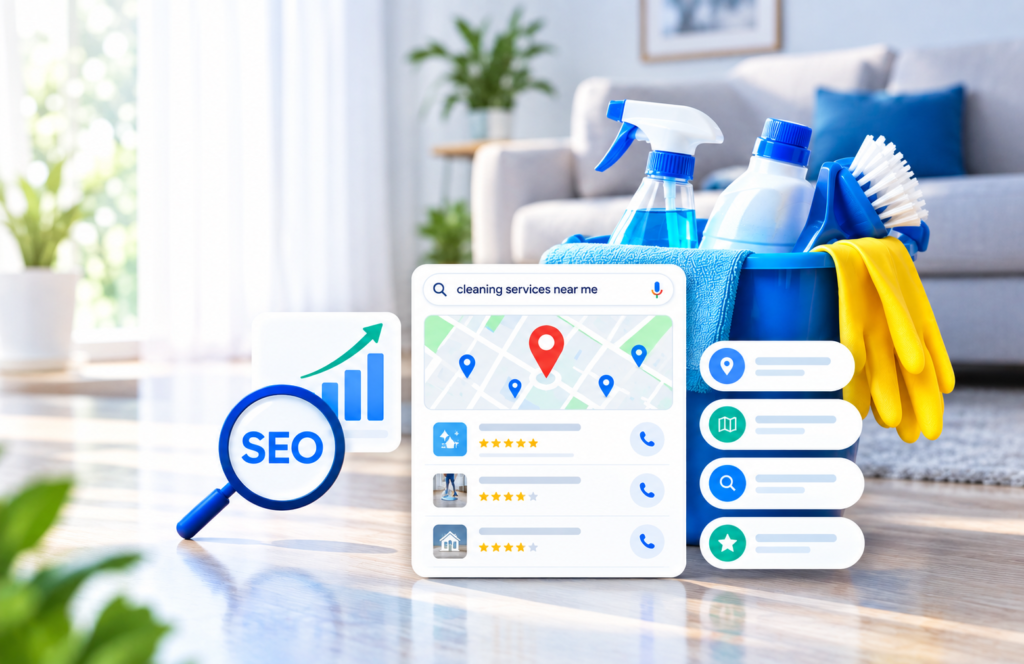
For most cleaning companies, the Google Business Profile (GBP) is the single most important ranking and conversion asset. It controls how you appear in the local map pack, which sits above the regular search results for nearly every local cleaning query.
Claim and verify the profile if you have not already done so. Complete every section thoroughly:
- Choose accurate primary and secondary categories (House Cleaning Service, Commercial Cleaning Service, Janitorial Service, etc.).
- Add every service you offer with clear descriptions.
- Upload high-quality photos of real work, your team, and before-and-after results on a regular basis.
- List your service areas accurately.
- Post weekly updates about seasonal offers, new services, or completed jobs.
- Respond to every review quickly and professionally.
Businesses that keep their GBP complete and active see significantly higher map-pack visibility. Aim for a steady flow of new reviews—ideally five or more per month—because review quantity and recency remain strong local ranking signals.
Step 2: Build Dedicated Service and Location Pages
One of the most common mistakes cleaning company websites make is trying to rank a single homepage for every service and city. Google rewards specificity.
Create separate pages for each core service, such as:
- Residential house cleaning
- Deep cleaning
- Move-in / move-out cleaning
- Commercial / office cleaning
- Post-construction cleaning
- Carpet or window cleaning (if offered)
Then expand into location pages for the cities or neighborhoods you serve. A page titled “House Cleaning in [City]” or “Move-Out Cleaning in [Neighborhood]” gives Google a clear signal about relevance and helps you rank for the exact phrases customers use.
Each page should include:
- The primary keyword near the beginning of the title and H1
- Clear explanation of what is included
- Pricing guidance or a free-quote call-to-action
- Real photos or short case examples from that area
- FAQ schema for common questions
These pages become the foundation of your organic visibility and give you natural places to link to from blog content and your homepage.
Step 3: Target the Right Keywords with Clear Intent
Cleaning keywords fall into three useful groups:
High-intent service + location terms
Examples: “house cleaning in Denver,” “commercial cleaning services near me,” “move out cleaning Austin.” These convert best and should map directly to your service and location pages.
Supporting informational terms
Examples: “how much does deep cleaning cost,” “what is included in a move-out clean,” “how often should I clean my office.” These attract people earlier in the research process and can be covered in blog posts that link back to your service pages.
Niche or specialty terms
Examples: “Airbnb turnover cleaning,” “medical office cleaning,” “eco-friendly house cleaning.” These often have lower competition and higher margins.
Focus first on terms that combine service and location. Broad national keywords such as “best cleaning company” are usually dominated by large brands and deliver weaker conversion rates for local operators.
Step 4: Collect and Showcase Reviews Systematically
Reviews influence both rankings and conversion rates. Google looks at the volume, velocity, and sentiment of reviews on your Business Profile. Potential customers look at them to decide whether they trust you.
Make review collection part of your standard process. After every completed job, send a short, polite request with a direct link to your Google review page. Respond to both positive and negative reviews promptly. Display recent reviews on your website service pages so visitors see social proof the moment they land.
Step 5: Strengthen the Technical and On-Page Foundation
Even the best content struggles if the website is slow or poorly structured. Prioritize:
- Mobile-friendly design (most local searches happen on phones)
- Fast loading times
- Clear navigation and internal links between service pages, location pages, and helpful blog content
- LocalBusiness and Service schema markup so Google understands exactly what you offer and where
- Consistent Name, Address, and Phone (NAP) information across the website, GBP, and directories
A clean, fast website also improves the user experience after someone clicks through from search or the map pack, which increases the chance they request a quote.
Common Mistakes That Keep Cleaning Companies Invisible
- Relying on a single generic homepage for every keyword
- Ignoring Google Business Profile optimization and reviews
- Publishing thin or duplicated location pages
- Focusing only on rankings instead of conversion (phone numbers, quote forms, and clear next steps)
- Treating SEO as a one-time project rather than an ongoing system
Avoiding these mistakes alone puts most small cleaning companies ahead of their local competition.
Measuring Progress and Expecting Realistic Timelines
Track the metrics that actually matter to the business: map-pack impressions and clicks, organic traffic to service pages, quote requests, and booked jobs attributed to organic search. Rankings are useful indicators, but leads and revenue are the real scoreboard.
Most cleaning companies that execute the fundamentals consistently begin seeing meaningful movement in local rankings within three to six months. Stronger results usually compound over the following six to twelve months as reviews accumulate, content expands, and authority builds.
Turning Visibility into a Steady Stream of Jobs
Local SEO for cleaning companies is not about chasing vanity rankings. It is about systematically appearing in front of people who are already looking for the exact services you provide in the areas you serve.
When your Google Business Profile is fully optimized, your website has clear service and location pages, you collect reviews consistently, and you publish helpful content that answers real customer questions, you create a durable source of inbound leads that compounds over time.
If you would like help implementing these strategies—whether through a full SEO campaign, a conversion-focused website redesign, or both—Growth Zenius specializes in practical SEO and web development for service businesses. A clear foundation and ongoing optimization turn search visibility into booked jobs.
Start with your Google Business Profile and one or two high-priority service pages this month. The businesses that treat local SEO as a core growth system rather than an afterthought are the ones that keep their calendars full.